 Same-day Appointments Book Online
Call to book 201.523.9590
Same-day Appointments Book Online
Call to book 201.523.9590
Same-day Appointments Book Online
Call to book 201.523.9590
Same-day Appointments Book Online
Call to book 201.523.9590
Table of contents
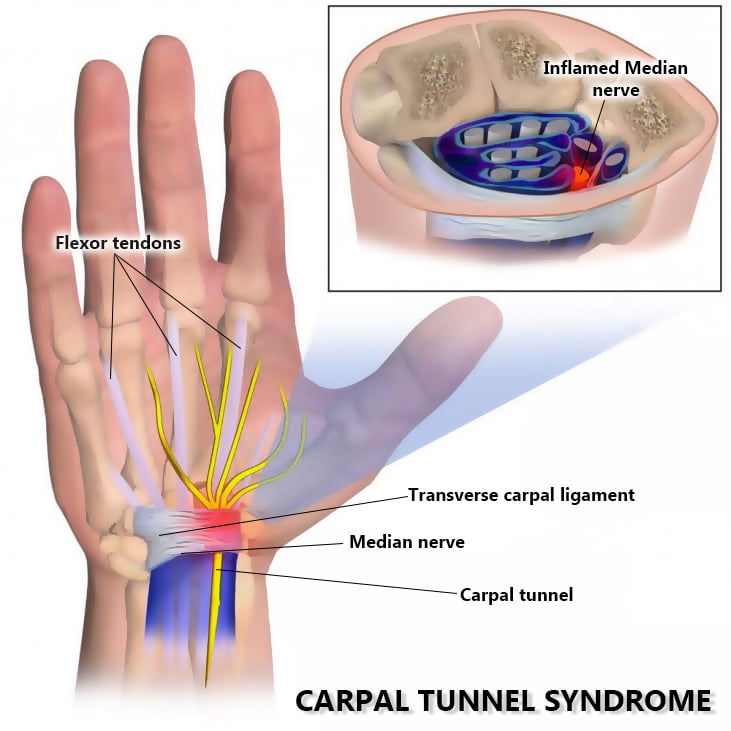
Carpal Tunnel Syndrome is a condition that causes hand, wrist and forearm pain. Carpal Tunnel Syndrome occurs when the connecting nerves from the hands to the forearms become compressed. This nerve is called the median nerve. Carpal Tunnel is a part of the hand where the ligaments and bones meet in the wrist.
When there is compression, irritation or swelling of the nerve, which passes through the carpal tunnel, Carpal Tunnel Syndrome may be present.
Carpal Tunnel Syndrome is commonly seen in patients who overuse their hands and wrists, especially in repetitive motions. Some things that can cause a flare up include typing on a keyboard, playing piano and writing. Other times, Carpal Tunnel Syndrome may be due to an injury such as a wrist sprain.
While anyone can be affected by Carpal Tunnel Syndrome, it is more common in middle aged women and patients with Arthritis.
Carpal tunnel syndrome often begins gradually. In the early stages, you might notice a subtle “pins and needles” sensation or a dull ache in your wrist. Many patients describe the feeling as their hand “falling asleep” at inconvenient times, such as while holding a steering wheel, a phone, or a book.
Nighttime flare-ups are a hallmark sign of the condition. Symptoms frequently intensify during rest because the wrist often flexes unconsciously, increasing pressure on the median nerve and causing enough discomfort or numbness to wake you from sleep.
 Amr Hosny, MD, MBA, FASA
Book Now
Amr Hosny, MD, MBA, FASA
Book Now
 David Chu, MD, FAAPMR
Book Now
David Chu, MD, FAAPMR
Book Now
 Vivek Mehta, MD, FAAPMR
Book Now
Vivek Mehta, MD, FAAPMR
Book Now
 Deepali Gupta, MD, DABA, DABPM
Book Now
Deepali Gupta, MD, DABA, DABPM
Book Now


While the symptoms focus on the hand and wrist, they can radiate up the arm toward the shoulder.
Key symptoms include:
Related article: Work-Related Injuries
Early diagnosis is the best way to prevent permanent nerve damage. The Spine & Rehab Group focuses on interventional, non-surgical recovery plans tailored to your lifestyle.
Treatment for Carpal Tunnel Syndrome may include:
The Goal of Treatment: Our primary objective is to reduce pressure on the median nerve, eliminate your pain, and restore the full strength and function of your hand without the need for invasive surgery.
I walked in with several issues including a herniated disc, pinched nerve, and carpal tunnel in both hands. Dr. Gupta took the time to address all of my issues and helped make a plan to best address my pain. Her help has been life changing for me. The staff is always professional, patient, and kind. I can’t thank them enough for all they have done.
Jocelyn Y. ★★★★★Dr Mehta was excellent, kind and gentle. I have had arm and hand pain for years and he was able to determine the problem in minutes. And the office staff is just as nice.
Lorraine V.If your job or hobbies require repetitive hand motions, these habits can help protect your wrists:
Don’t wait until hand weakness makes daily tasks impossible. The specialists at The Spine & Rehab Group utilize diagnostic tools like EMG (Electromyography) to precisely locate nerve compression and initiate your recovery on the right path. Contact us today to schedule your consultation at our Manhattan or New Jersey pain treatment centers.
The Spine & Rehab Group
140 NJ-17,
Paramus, NJ 07652
(212) 242-8160